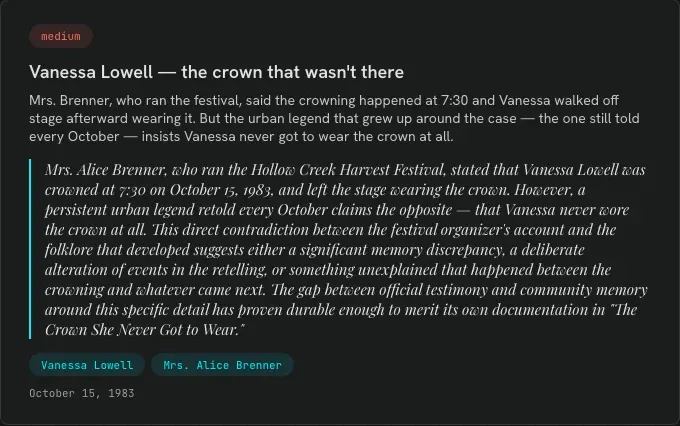
On the night of October 15, 1983, seventeen-year-old Vanessa Lowell was crowned queen of the Hollow Creek Harvest Festival, walked toward the equipment area behind the stage, and was never seen again. The county sheriff’s office searched for weeks. The trail went cold. The town kept holding the festival anyway, every October, because — as one resident put it in an oral history decades later — “if we stopped, it meant we’d given up on finding her.”
Hollow Creek is a fictional Appalachian town built to test something specific: can an AI world-building engine hold a small-town mystery straight across dozens of documents written from completely different angles — a grieving mother’s oral history, a sheriff’s department case file, a therapist’s session notes, a Reddit thread of amateur investigators, a county clerk’s land-records audit — without the facts drifting?
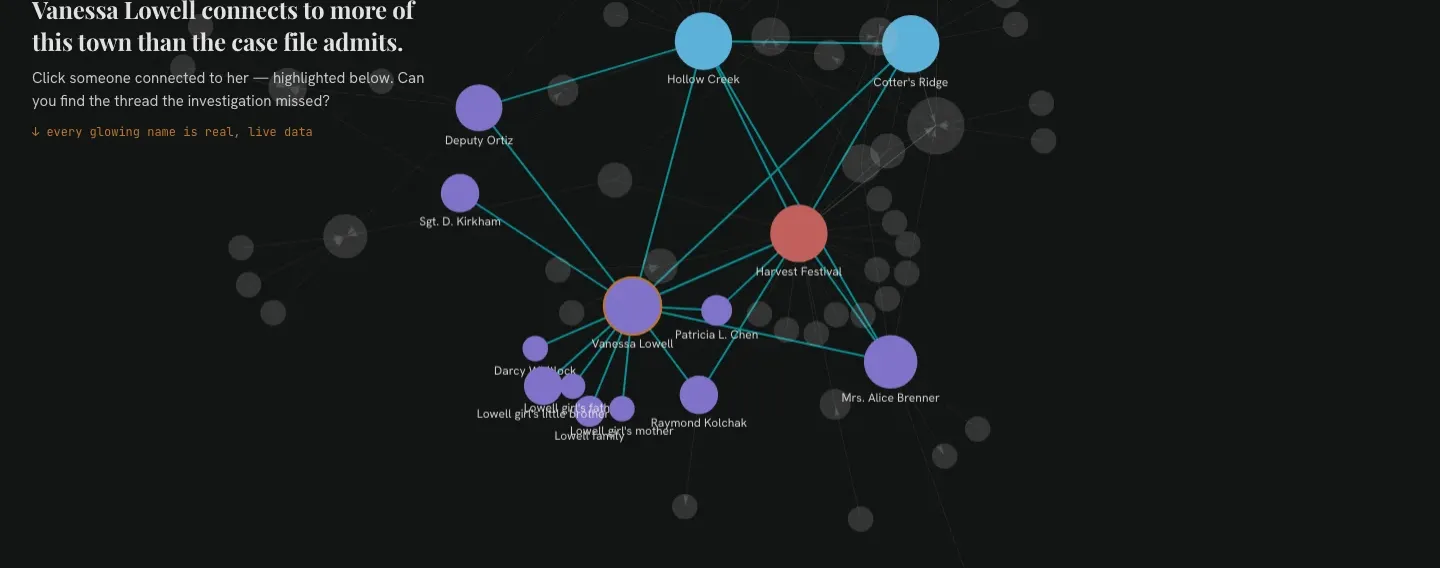
What the canon graph actually holds
The disappearance connects to something nobody in 1983 was looking for: the Hollow Creek Municipal Trust, a “semi-public entity” that has quietly controlled the land under the old Gaskill mining district since 1974 — including the exact acreage where Vanessa was last seen. A records clerk auditing seventy-year-old land filings for a digitization project found parcels that were sold to private buyers in the 1950s and 60s, then somehow re-appear as Trust property in 1974, with no legitimate paper trail between the two.
We’re required to maintain chain of title. When you see the same parcel number appear in contradictory sequences, that’s a problem. These aren’t transcription errors. These are separate filed documents that can’t both be true.
Eighteen months of silence from the county sheriff’s office. Eighteen months of a family waiting for answers that should have come within eighteen days… The fact that her disappearance occurred on land administered by the Hollow Creek Municipal Trust, an entity with complex and recently disputed land records, adds a layer of institutional entanglement that may have discouraged rather than intensified official scrutiny.
No single document claims the Trust is responsible for what happened to Vanessa Lowell. That’s deliberate — the mystery holds together because each artifact only knows what it would plausibly know, and the canon graph is what lets a reader (or the engine itself) notice that a sealed 1947 deed, a 1974 Trust filing, and a teenager’s last known footsteps all point at the same acreage.
Built with a human in the loop
Every one of Hollow Creek’s 38 canon documents was generated, read, and individually accepted into canon — nothing was bulk-approved. The world currently holds a 96.0 Canon Integrity score, meaning the reconciliation engine’s identity, timeline, relationship, and continuity checks find almost nothing left to flag across nearly a thousand tracked canon facts.