Your world is bigger than a prompt.
Universe Engine is built for creators whose stories have become too large to hold in their heads.
Build characters, places, organizations, history, relationships, rules, and in-world artifacts inside a persistent fictional universe — then let that universe grow without losing track of what is canon.
Six ways creators are already building with it.
Different mediums, the same underlying need — a world that holds its own history so you don’t have to.
Remember everything your world does.
A character introduced two books ago. A promise made in chapter twelve. The history of a town, and who knew what — and when. Universe Engine gives your fictional world a persistent memory, so starting book three doesn't mean rereading books one and two just to stay consistent.
- —Track characters, locations, organizations, and relationships as connected Canon Facts
- —Preserve historical and story timelines across an entire series
- —Set lore, cultural, and narrative rules once in a Blueprint — every generation respects them
- —Generate new material grounded in what your world already established
- —Canon Intelligence surfaces contradictions before a reader does
- —Explore new stories inside the same world without starting its canon over
Stop rereading your own world just to remember what’s true.
Build worlds that can survive hundreds of stories.
Game worlds accumulate NPC histories, factions, locations, lore, and institutions faster than any one writer can hold in their head — and every quest, sidequest, and expansion has to stay consistent with what came before.
- —Model factions, NPCs, settlements, and institutions as connected entities
- —Preserve the cultural and historical rules a Blueprint sets for your world
- —Generate in-world documents and environmental storytelling grounded in canon
- —Track how one event ripples through the Relationship Graph around it
- —Canon Intelligence flags lore contradictions as your world keeps expanding
Your world should get deeper as it grows — not harder to understand.
Give your campaign a memory.
Players turn minor NPCs into major characters and forgotten details into campaign-defining events. Universe Engine gives those moments somewhere permanent to live, instead of scattered session notes only you can decipher.
- —Establish your campaign setting, history, and factions as governed Blueprints
- —Keep recurring NPCs and canon events consistent from session to session
- —Generate letters, reports, legends, journals, and handout-style artifacts your players can hold
- —Preserve the relationships your table’s decisions actually created
- —Surface unresolved threads as inspiration for future sessions
Your campaign remembers, even when you don’t.
Build the world behind the script.
Long-form and serialized stories carry continuity across episodes, seasons, characters, and organizations that no single script has room to hold. Universe Engine keeps that continuity somewhere your writers’ room can actually consult.
- —Develop characters and organizations beyond any single episode or script
- —Preserve season-spanning relationships and historical events
- —Track locations, cultures, and institutions as your world’s Canon Graph grows
- —Canon Intelligence surfaces continuity gaps before production has to
- —Surface unresolved narrative opportunities for future seasons
A story bible that understands how its pieces connect.
Build the truth first. Then scatter the evidence.
Establish the people, events, secrets, institutions, history, and relationships underneath your mystery — then let the story emerge through evidence your readers actually investigate: police reports, witness statements, newspaper articles, letters, photographs, evidence logs, court records, medical records, transcripts, receipts, social posts, historical documents, even conflicting accounts.
Readers don’t have to be told what happened. They can investigate the world and decide for themselves.
Hollow Creek, West Virginia
In 1983, seventeen-year-old Vanessa Lowell disappeared during the Hollow Creek Harvest Festival. Decades later, the truth is buried across police records, property documents, witness statements, photographs, newspaper articles, transcripts, court filings, and the history of the town itself.
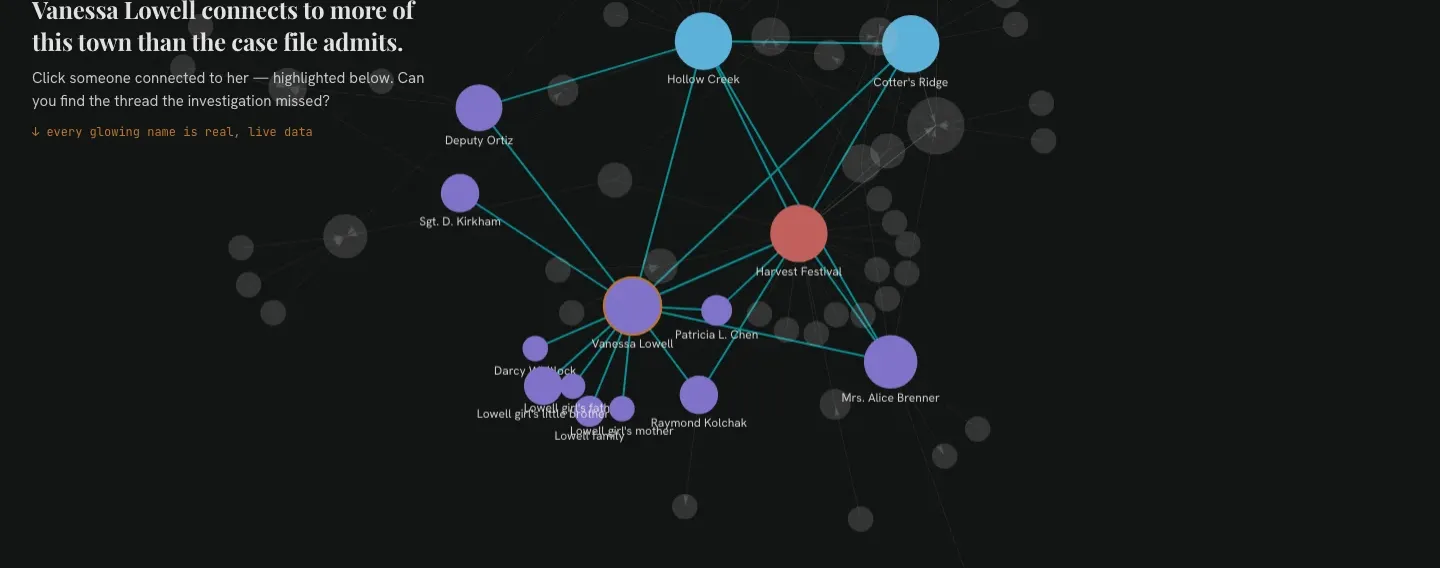
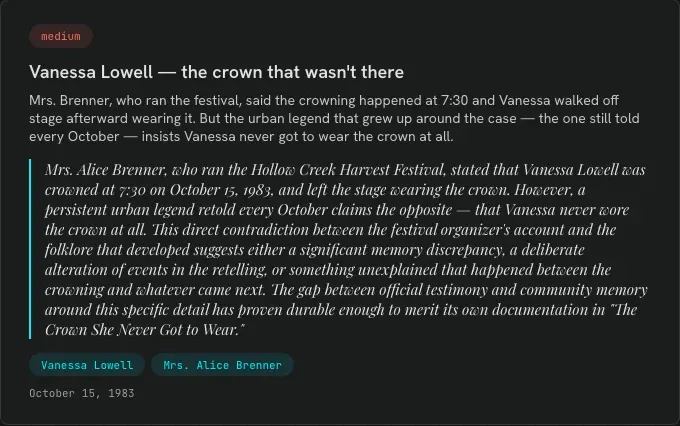
One world. Many forms of evidence.
A universe doesn’t need to live only in prose or chapters. Documents, correspondence, news, institutional records, transcripts, and visual evidence can all draw from the same governed canon and the same Relationship Graph.
- —Generate documents, correspondence, news, and institutional records from one canon
- —Keep every character’s perspective consistent across formats
- —Preserve historical material and transcripts as part of the same timeline
- —Canon Intelligence keeps every format honest to the same underlying facts
Create the world behind the rabbit hole.
If your medium isn’t on the list above.
Continuity gets harder with every issue.
Characters, powers, factions, and organizations all have to hold together across dozens of issues. Universe Engine tracks the canon rules — and the history — a growing universe depends on.
Build a universe designed to outlive its first story.
Give recurring stories somewhere to live.
Fiction podcasts, audio dramas, newsletters, and other recurring fictional series all return to the same characters and world, episode after episode. Universe Engine keeps that world consistent between installments.
Build once. Return to the world again and again.
Every use case above runs on the same world model.
Build the world. Preserve the canon. Tell more stories inside it.
Persistent Canon
Decide what becomes true, and preserve it as the universe grows. Canon Facts are evidence-backed and carried forward into every future generation.
Connected Entities
Characters, places, organizations, events, and concepts exist as parts of a larger system, not isolated notes.
Relationship Graph
Understand how people, places, organizations, and events connect — and see the ripples when one fact changes.
World Blueprint
Define lore, history, culture, narrative voice, themes, priorities, and world rules once. Every generation run respects them.
In-World Artifacts
Generate material that feels like it was produced inside the universe — reports, letters, transcripts — grounded in canon, not written about it from outside.
Canon Intelligence
Scan your entire canon for contradictions, timeline conflicts, forgotten characters, and continuity gaps.
Reconciliation
When new material conflicts with established canon, nothing merges automatically. You decide what the world should remember.
You don’t need another blank page. You need a world that remembers.
Whether you’re building a novel series, a campaign setting, a game universe, a mystery, a screenplay, or something that doesn’t fit neatly into any medium, Universe Engine gives your fictional world structure beneath the story.