
Councilman Robert Landry chaired Harbor Point’s Development and Planning Committee for eleven years. In August, he cast the deciding vote to approve a $1.2 billion waterfront redevelopment for Meridian Atlantic Group. In September, the pier at the center of that project closed to the public for “preliminary work.” In October, marina staff found his body in the water below it.
We built Harbor Point to stress-test a different kind of consistency than a missing-persons case. Not “does everyone’s story match” — can the engine hold a paper trail straight: two decades of campaign contributions, zoning votes, consulting retainers, and a land transfer, spread across newspaper investigations, court filings, police reports, and a council vice president’s on-the-record denial, without any of it contradicting itself.
The trail nobody had to dig for
A campaign-finance review connects Meridian Atlantic’s donations directly to the officials who later voted on its projects — $18,500 to the state senator who sponsored the coastal redevelopment law Meridian’s approvals depended on, plus contributions to three council members who voted for a rezoning package four years later. One of the developer’s consulting firms is run in part by a sitting council vice president’s brother.
Between 1997 and 2023, entities connected to Meridian Atlantic contributed at least $347,000 to state and local campaigns, with donations concentrated in election cycles immediately preceding major land-use votes.
— newspaper investigation, campaign finance records review
The night before Landry died, a colleague remembers an ordinary conversation:
He mentioned wanting to walk the pier one more time before construction equipment moved in next week. Bob took these decisions seriously. He wanted to see the site for himself.
— Councilwoman Jisoo Liang
Nothing in the canon states outright that Landry’s death was anything other than what the police chief’s statement calls it: he “slipped on wet planking.” That restraint is deliberate — Harbor Point’s tension comes from a reader connecting an ordinary-sounding accident to a very carefully documented paper trail, not from the world announcing a conclusion.
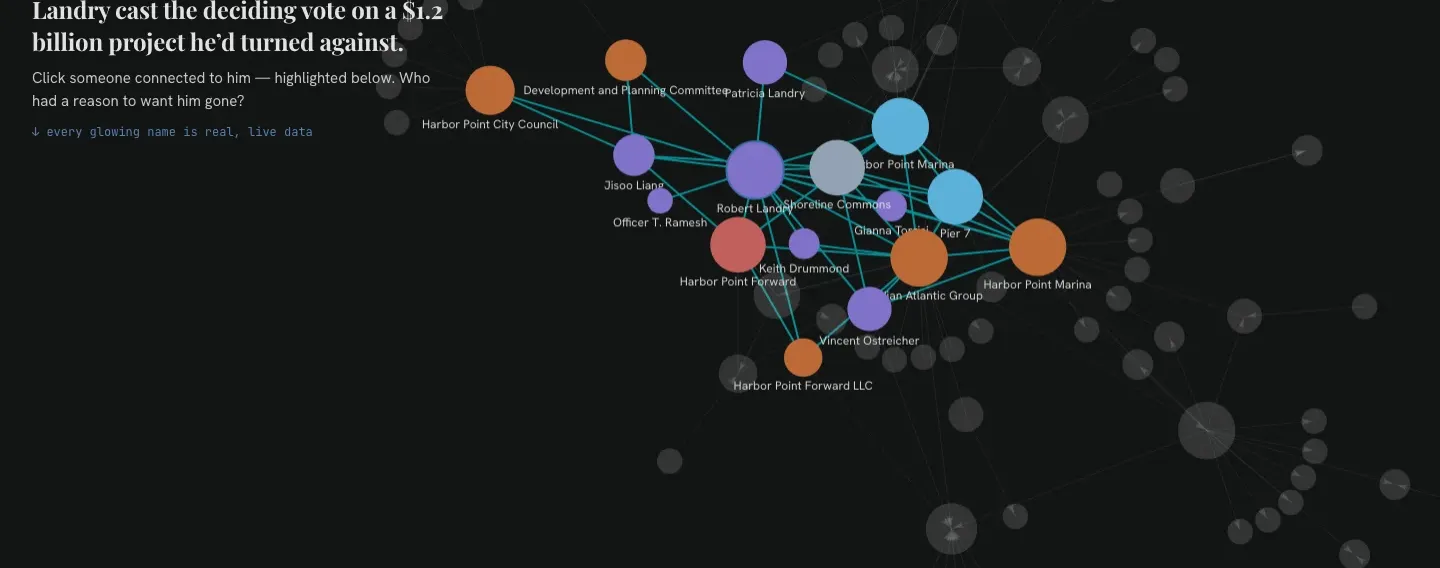
Then the engine flagged something the writers didn’t put there on purpose
Harbor Point’s canon graph doesn’t just hold a paper trail straight — it watches for a shape of contradiction no single document would ever notice on its own. Deep in the world’s correspondence, the reconciliation engine surfaced this, unprompted, at “high” severity:
Robert Landry died on October 4. But a work email from Keith Drummond, dated October 11 — “Rob — thanks for fast-tracking” — addresses him as alive and actively involved in a project. Text messages between two other characters, discussing Landry’s death, refer to an upcoming vote on the Shoreline Commons development as something still in front of him. That vote happened on the same day as Drummond’s email.
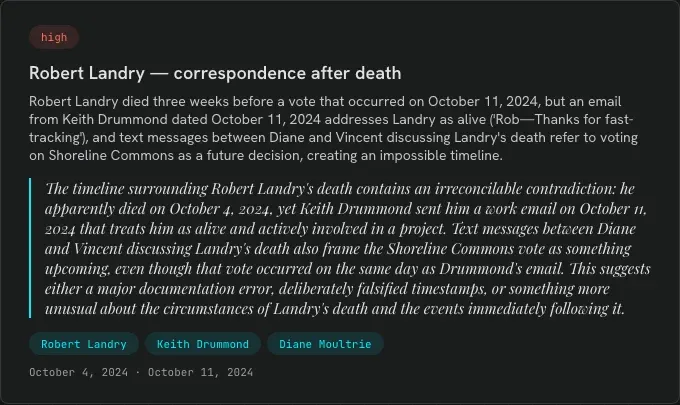
Nobody wrote those three documents intending to create a contradiction. An email, a text thread, and a death record were each generated independently, each internally consistent, each accepted into canon on its own merits. It’s the graph connecting all three against a single timeline that caught what none of them could see alone — exactly the kind of error a human editor might miss on a read-through, and exactly what a reconciliation engine is for.
Built with a human in the loop, all thirty-seven times
Every one of Harbor Point’s 37 canon documents was individually reviewed before being accepted into canon. The world holds a 98.5 Canon Integrity score across more than a thousand tracked canon facts — the reconciliation engine’s identity, timeline, and continuity checks turn up almost nothing left to resolve. When they do find something, this is what it looks like.
Investigate Harbor Point yourself — no signup required. Or read the full case study first.