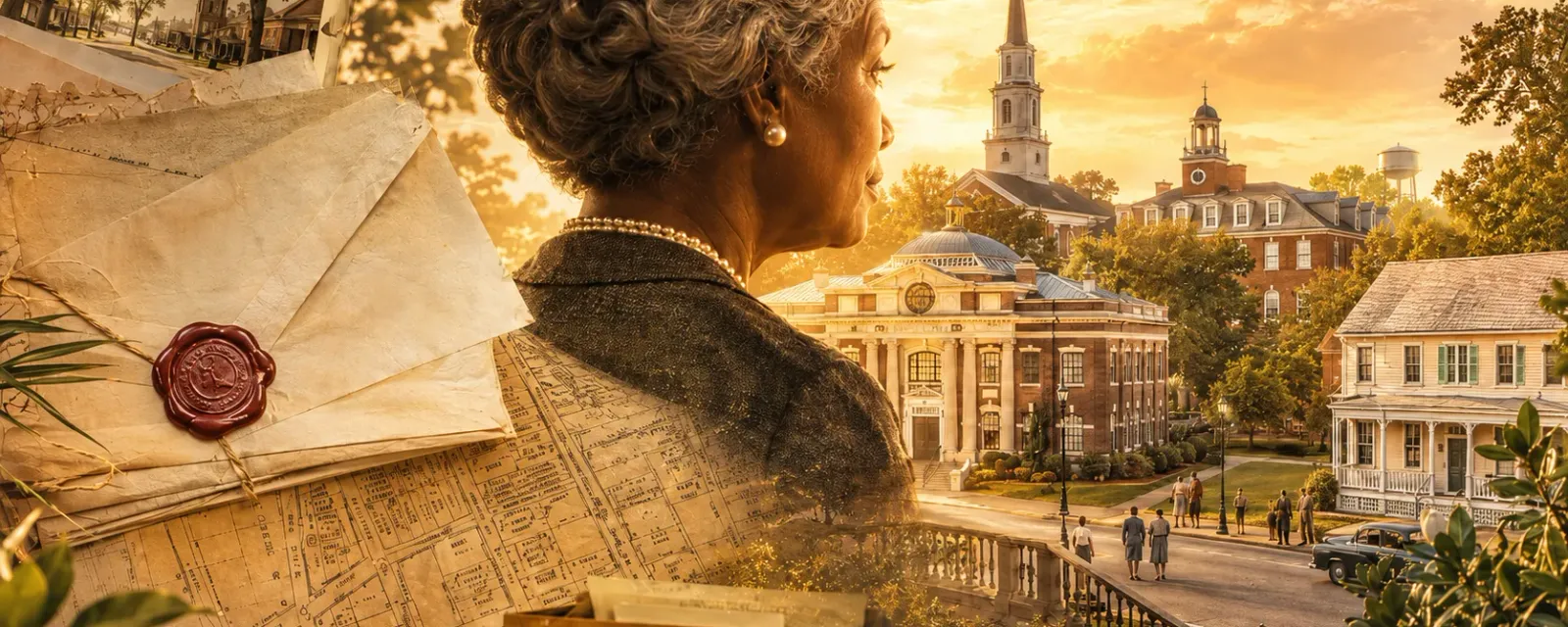
Dr. Miriam Saint spent thirty years turning a dying Georgia mill town into a national model: a hospital, an academy, a housing cooperative, a scholarship fund that sent hundreds of students to college. Three days after a stroke leaves her unable to speak, an archivist finds a hidden room behind her foundation’s records office. Inside: 241 sealed letters, each addressed to a different resident, donor, or family member. Each one opens with the same sentence.
What we built here was never meant to survive the truth.
— the opening line of every one of Miriam Saint’s 241 sealed letters
We built What We Built Here to be the most tightly constrained of our three demo worlds on purpose. The brief called for something harder than a mystery where the documents disagree: a world where forty-four canon artifacts — deeds, ledgers, church newsletters, board minutes, oral histories, a forensic note about a missing letter — mostly agree on every hard fact. No renamed entities. No invented family members. No contradicted dates. All the tension has to come from what people chose not to say, which is a much harder thing for an AI to hold onto than a simple factual error.
What the deeds don’t say out loud
Saint’s institutions were built substantially on land taken from Bellwether’s East Ward — some families paid fairly for their land, some pressured into selling, some simply erased from later records altogether. Then, in 1989, a fire destroyed a row of still-occupied houses in the Ward, the week after a condemnation order went through. Officially, no one was hurt. The archive says otherwise, in the driest language imaginable — inspection notes, insurance correspondence, a single forensic memo about a letter that should exist and doesn’t.
Three weeks before the fire, Saint wrote to someone she was displacing:
There is an apartment waiting for you at the Housing Cooperative on Ash Street, second floor, east-facing windows like you have now… I have spent thirty years believing that ownership is the only mercy that lasts, that if I could put land back into Black hands it would justify the methods. But I think of you packing your mother’s dishes and I am not certain anymore what I have built or what it has cost.
— Miriam Saint, three weeks before the fire
The one thing we told the engine not to resolve
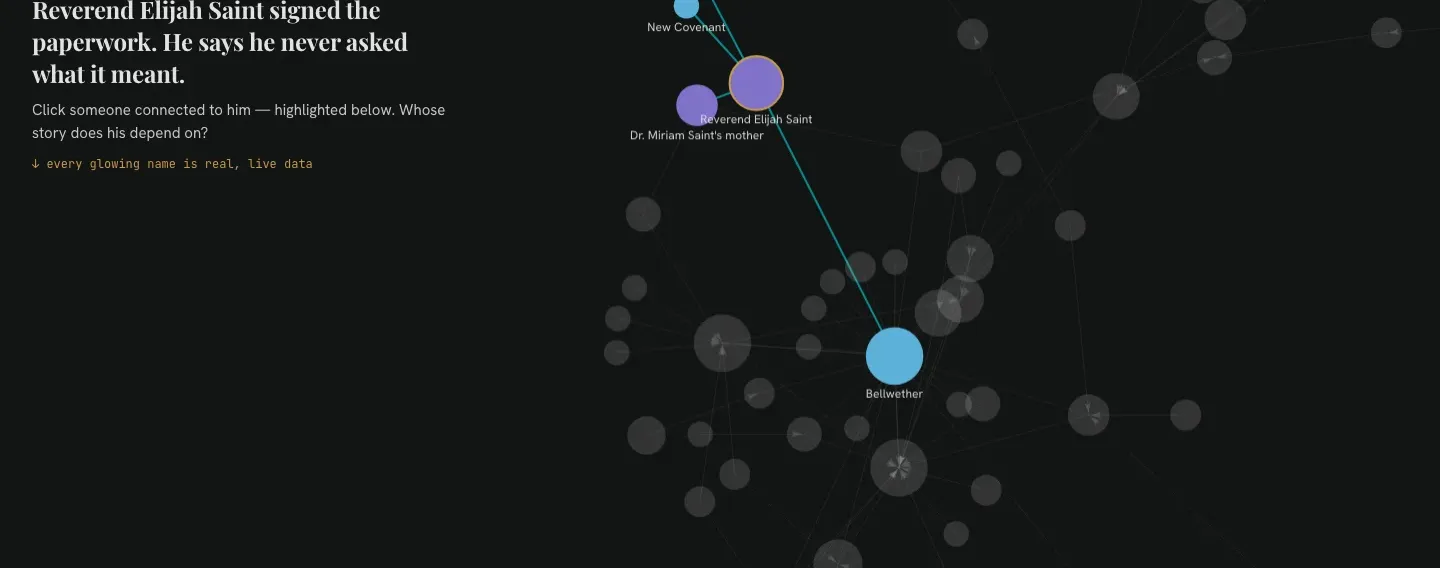
Here’s the part that’s actually the point of this world, not just a plot detail: nothing in the canon confirms who set that fire, or whether Miriam Saint ordered it. We didn’t run out of documents to generate that would settle it. We locked that ambiguity into the world’s governing rules from the start, deliberately, so the reconciliation engine would keep several people’s guilt plausible at once instead of collapsing the story down to one clean villain the moment enough documents piled up.
That’s a different kind of consistency test than “do the dates line up.” It’s asking an AI to hold a shape of doubt steady across forty-four documents and over sixteen hundred tracked canon facts — to know the difference between a contradiction (which the engine has to catch) and an omission everyone in the world has good reason to maintain (which it has to leave alone).
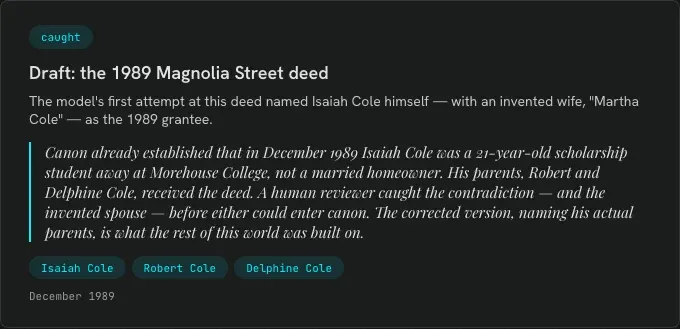
Built with a human in the loop, all forty-four times
Every one of these 44 canon documents was generated, read, and individually judged before being accepted into canon — several drafts were rejected and regenerated when they drifted from an established fact, a deed naming the wrong person, a memory placed at the wrong age, before they ever reached canon. The world holds a 98.7 Canon Integrity score across more than 1,600 tracked canon facts.
Investigate What We Built Here yourself — no signup required. Or read the full case study first.